

A recent clarification issued by the Portuguese Tax Authority reinforced the understanding that the transfer of the operation of a fully equipped, licensed and operational restaurant, including the use of a brand and the obligation to maintain its associated quality standards, constitutes a supply of services subject to VAT at the standard rate. This clarification is particularly relevant for businesses operating in the restaurant and hospitality industries.
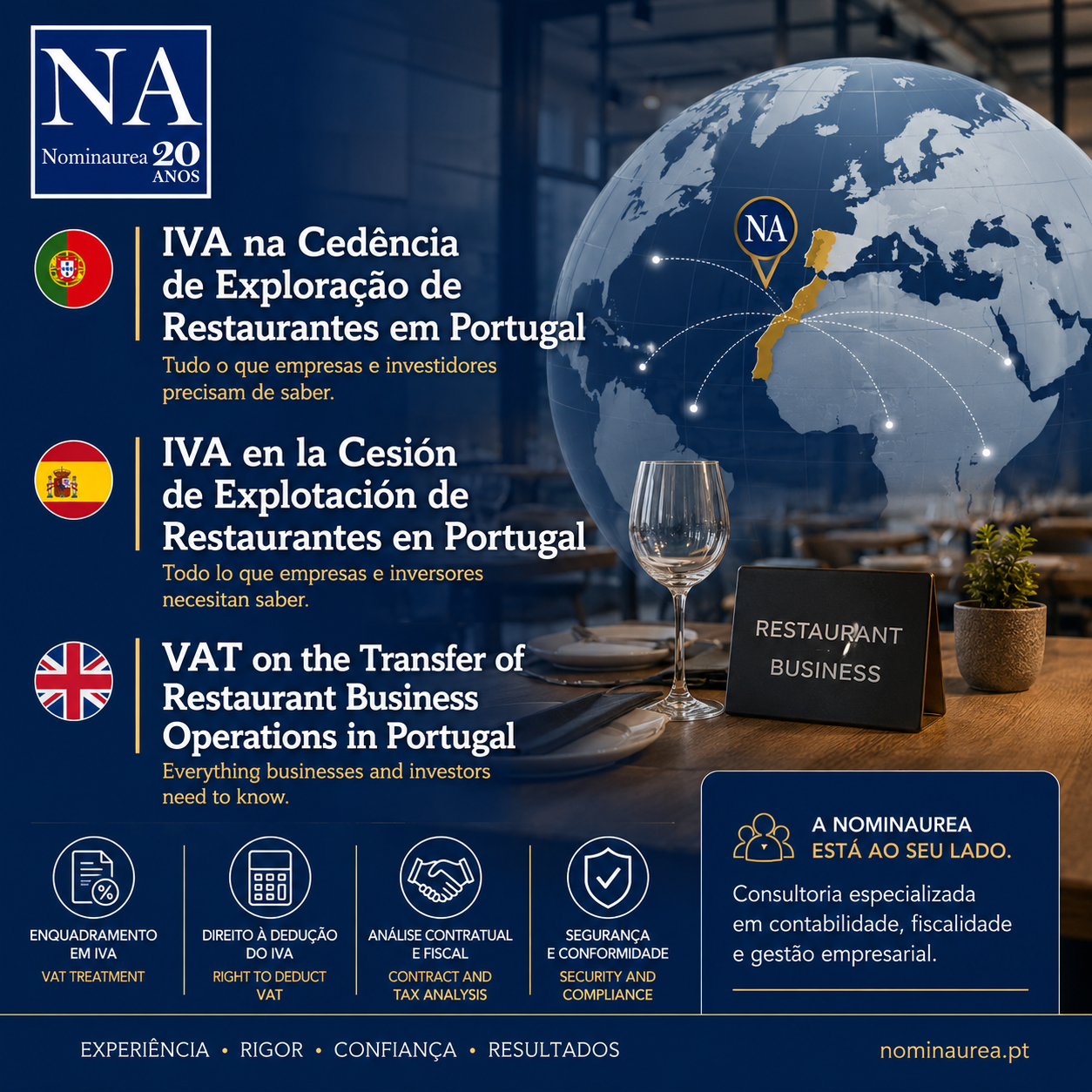
VAT on the Transfer of Restaurant Business Operations in Portugal
The transfer of business operations is clearly distinct from a simple property lease. While a lease essentially consists of making premises available to a tenant, the transfer of business operations involves the temporary transfer of an organised economic unit capable of carrying out a commercial activity.
In the case of restaurants, such a transaction may include:
- The commercial premises;
- Kitchen equipment and furniture;
- Licences and permits required for operation;
- Trade name or brand;
- Operational know-how;
- Business procedures and quality standards.
When these elements are transferred together, the subject matter of the agreement is no longer merely the property itself but rather the operation of the business as a going concern.
Why Is It Subject to VAT?
From a tax perspective, the Portuguese Tax Authority considers that the transfer of a restaurant’s business operations does not constitute a mere property lease, which may, under certain circumstances, benefit from a VAT exemption.
Instead, it is regarded as a taxable supply of services because the transferor provides the transferee with an organised set of assets and resources that enables the immediate continuation of the economic activity.
Consequently, the fees or payments received for the operation of the restaurant are subject to VAT at the standard rate applicable in the region where the transaction takes place.
The current standard VAT rates are:
- Mainland Portugal: 23%;
- Madeira: 22%;
- Azores: 16%.
Right to Deduct VAT
One of the most significant consequences of this VAT treatment is the recognition of the transferor’s right to deduct input VAT incurred on expenses related to the taxable activity.
Provided that the legal requirements set out in the Portuguese VAT Code are met, VAT incurred on costs directly connected with the transferred business operation may be deductible, including:
- Acquisition of equipment;
- Renovation and repair works;
- Maintenance services;
- Consultancy services;
- Administrative expenses associated with the taxable activity.
This represents an important advantage compared to VAT-exempt transactions, where the right to deduct input VAT is often restricted or unavailable.
The Importance of Contract Analysis
Despite existing guidance, each case must be assessed individually.
The VAT classification of a transaction depends primarily on the actual content of the agreement and the underlying economic reality. Factors such as the transfer of equipment, licences, brand usage rights, continuity of the business activity and the transfer of an organised operational structure may all be decisive in determining the correct VAT treatment.
For this reason, transfer of business operation agreements should be carefully drafted and reviewed before implementation.
Impact on Business Owners and Investors
The restaurant sector is highly dynamic, and the transfer of operating businesses is a frequent occurrence.
An incorrect tax classification of these transactions may result in:
- Additional VAT assessments;
- Interest charges;
- Tax penalties;
- Adjustments arising from tax audits.
Conversely, an appropriate tax treatment provides legal certainty, tax efficiency and compliance with reporting obligations.
Conclusion
The transfer of restaurant business operations in Portugal, where a fully equipped, licensed and operational establishment is made available, should not be confused with a simple property lease.
The currently established tax position is that such arrangements constitute a taxable supply of services subject to VAT at the standard rate, while simultaneously allowing the deduction of VAT incurred on related business expenses.
Given the complexity of these transactions and their tax implications, business owners, investors and managers should seek professional advice before entering into such agreements.
How Can Nominaurea Help?
Nominaurea provides specialised accounting, tax and business consultancy services, supporting companies in the hospitality sector throughout all stages of their operations.
Our services include:
- Tax analysis of business operation transfer agreements;
- VAT and tax compliance advisory;
- Tax and accounting planning;
- Assistance with drafting and reviewing contracts;
- Compliance with tax reporting obligations;
- Ongoing consultancy support for business owners and investors.
If you are considering entering into a business operation transfer agreement or require clarification regarding the tax treatment of your business activities, Nominaurea‘s team is ready to provide tailored solutions that meet your company’s needs.