

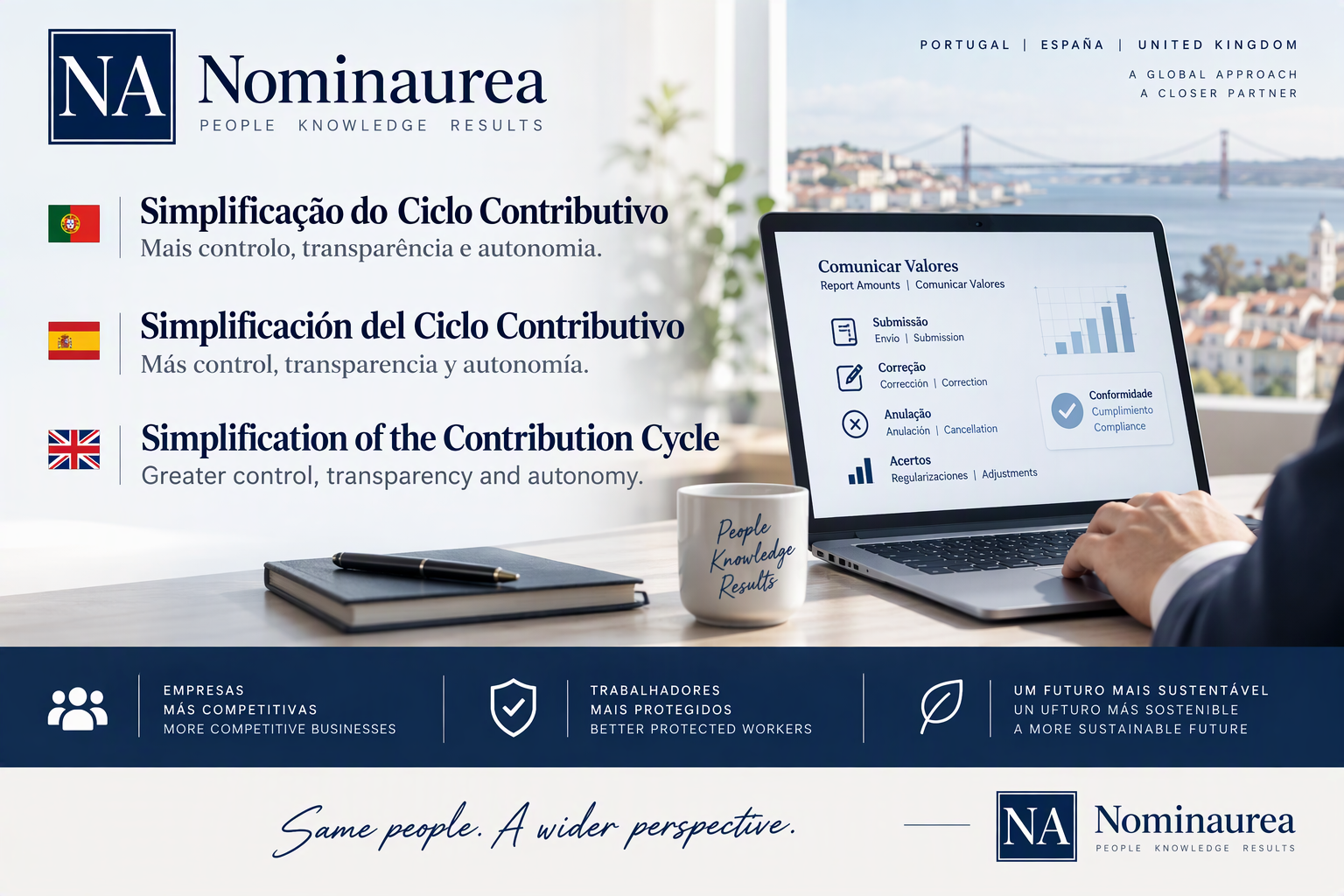
What is the Simplification of the Contribution Cycle?
The Simplification of the Contribution Cycle changes the traditional way in which remuneration is reported to Portuguese Social Security.
The new system uses information already available for each worker, including employment relationships, applicable contribution rates, certain remuneration amounts, working days and interruptions known to Social Security, as well as potential reductions resulting from employment incentives.
Portuguese Social Security will therefore automatically calculate and present the contribution obligation, while the employer will be responsible for confirming, amending or reporting new amounts and subsequently making the corresponding payment.
However, this does not mean that employers are relieved of responsibility for the accuracy of their information. On the contrary, increased automation makes it even more important to ensure that employment relationships, remuneration and subsequent changes are correctly recorded and kept up to date.
“Comunicar Valores”: Understanding the Replacement Principle
One of the key aspects of managing the new model is understanding that a new submission concerning the same combination of elements should not simply be regarded as an additional amount.
Under the “Comunicar Valores” functionality, the key principle is replacement: when a new amount is reported for the same employee, period, qualification and remuneration type, the new amount replaces the amount previously reported.
This is particularly important where duplicate submissions occur or where a company subsequently identifies an error in its payroll processing.
Practical example
Suppose a company reports remuneration of €1,500, but subsequently determines that the correct amount should have been €1,650.
Under the replacement model, the correction should not simply consist of reporting the additional €150 difference. Instead, the new submission should state the correct total amount of €1,650, replacing the previous submission.
This approach reduces the risk of duplication resulting from successive submissions.
How Can a Previously Reported Amount Be Corrected?
When a company identifies that an amount previously reported is incorrect, it should make a new submission containing the correct total amount that should remain recorded, while maintaining the same employee, period, qualification and remuneration type.
Payroll, HR and accounting departments should therefore clearly understand this logic.
Instead of asking:
“How much do we still need to add?”
the key question should be:
“What is the correct total amount that should be recorded?”
This apparently simple distinction can prevent significant errors in the calculation of social security contributions.
What If an Amount Needs to Be Cancelled?
The opposite situation may also arise: remuneration has been reported but it is subsequently established that it should not have been included.
Following the replacement principle, the amount can be cancelled by submitting a new communication of €0, while maintaining the remaining identification details of the original submission.
The previous transaction is therefore not simply deleted. Instead, a new submission is made establishing that the correct amount to be considered is zero.
From an internal control perspective, companies should maintain supporting records explaining why the correction was necessary, particularly where it arises from subsequent changes to payroll processing.
Positive and Negative Adjustments: A Different Approach
It is important to distinguish between replacing an amount and making an adjustment.
The new contribution framework provides specific functionality for adjustments to previously reported remuneration.
Through the “Enviar Valores de Remuneração por Acerto” (Submit Remuneration Amounts by Adjustment) service, employers must pay particular attention to whether the transaction is intended to represent an adjustment or a replacement.
When “Acerto” = “Sim” (Adjustment = Yes)
The amount reported operates as a variation of the amount already recorded and may therefore be positive or negative.
For example:
- Amount recorded: €1,500
- Adjustment reported: +€150
- Resulting amount: €1,650
For a negative adjustment:
- Amount recorded: €1,500
- Adjustment reported: -€100
- Resulting amount: €1,400
When “Acerto” = “Não” (Adjustment = No)
The approach is no longer incremental. The amount submitted should represent the new correct total, replacing the amount previously recorded.
This distinction is crucial. Confusing an adjustment of +€150 with a replacement amount of €150 would produce completely different results.
A New Process Requiring Greater Internal Control
Automation does not remove the need for checks and controls. Instead, it changes where and how those controls should be performed.
Companies should establish procedures allowing them to compare:
- the amounts resulting from payroll processing;
- the amounts reported to or already known by Portuguese Social Security;
- any subsequent changes or remuneration components;
- the final amounts used to calculate social security contributions;
- any adjustments or replacements subsequently made.
The new model provides mechanisms for reviewing amounts calculated for each employee and monitoring contribution obligations from both monthly and annual perspectives.
This can considerably facilitate reconciliation between payroll, accounting records and Portuguese Social Security, provided that appropriate internal controls are in place.
Preparing for the Transition During 2026
Implementation of the Simplification of the Contribution Cycle is taking place progressively throughout 2026.
Once an employer joins the new system, the change takes effect in the following month and is irreversible. During the transition period, the traditional system and the new model may therefore coexist, depending on each employer’s circumstances.
Under the implementation timetable, all employers will be covered by the new contribution model from 1 January 2027.
Companies should therefore use the remaining transition period to review:
- the configuration of their payroll software;
- information relating to employees and their employment relationships;
- procedures for reporting variable remuneration;
- internal validation and approval procedures;
- processes for corrections and cancellations;
- the treatment of positive and negative adjustments;
- reconciliation between payroll, accounting records and social security contribution obligations.
This is therefore much more than an IT change. It represents a genuine change in payroll and contribution management processes.
Greater Control, Transparency and Autonomy
The Simplification of the Contribution Cycle is intended to reduce recurring administrative obligations and make the contribution process more digital, automated and predictable.
For employers, this evolution can reduce repetitive administrative work, but it also places greater emphasis on the quality and accuracy of the underlying information.
The more automated the system becomes, the more important it is to ensure that employment relationships, remuneration, qualifications and remuneration types are correctly recorded.
Companies should therefore view the new system not simply as a different method of reporting information, but as an opportunity to strengthen the connection between payroll processing, internal controls and social security compliance.
Conclusion
The Simplification of the Contribution Cycle represents a significant change in the management of employers’ social security obligations in Portugal.
Regarding the “Comunicar Valores” functionality, understanding the replacement principle is essential: where a previous submission needs to be corrected, the employer should report the new correct total amount, rather than simply adding the difference.
Where the specific adjustment mechanism is used, it is equally important to distinguish between an operation that adds or subtracts an amount and one that completely replaces the amount previously reported.
With the new model becoming applicable to all employers from 1 January 2027, preparing processes, systems and teams is no longer simply a matter of technological adaptation. It is becoming an essential part of effective payroll control and compliance with Portuguese Social Security obligations.
How Can Nominaurea Help?
Nominaurea can support companies throughout their transition to the Simplification of the Contribution Cycle, helping to ensure that the new model is implemented alongside appropriate payroll, validation and control procedures.
Our support can include:
- assistance with the transition to the new contribution model;
- review of payroll procedures;
- validation of remuneration and the corresponding remuneration types;
- support in identifying and correcting discrepancies;
- assistance with replacements, cancellations and adjustments;
- reconciliation between payroll information and amounts recorded by Portuguese Social Security;
- support with ongoing employment and social security compliance obligations;
- continuous monitoring of relevant changes affecting employers with employees in Portugal.
As payroll and social security processes become increasingly automated, Nominaurea’s objective is to help companies turn administrative simplification into greater security, control and efficiency in managing payroll and social security obligations in Portugal.