


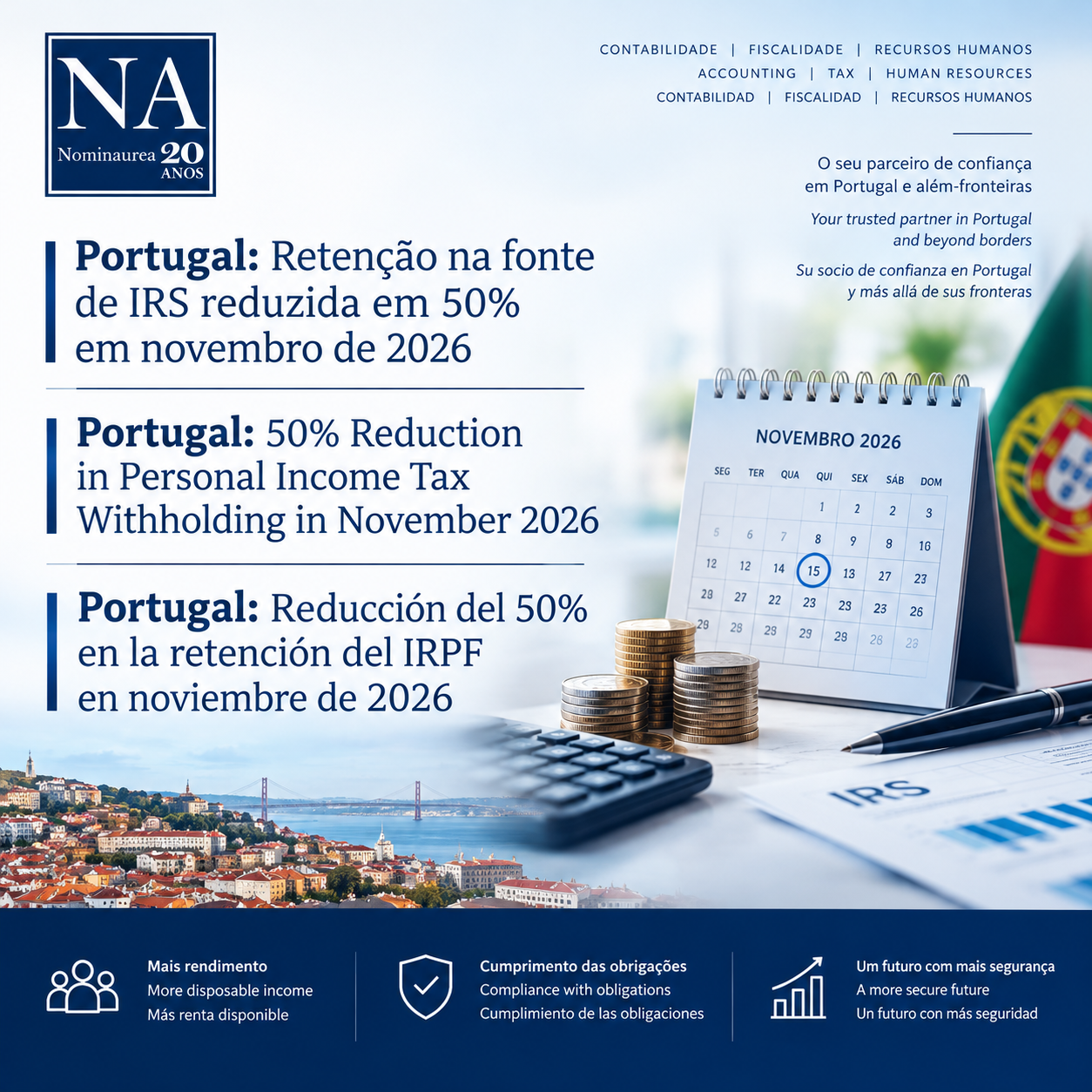
What is changing in personal income tax withholding in Portugal?
The Portuguese Government has approved an extraordinary adjustment to personal income tax withholding for November 2026, following the reduction in the general tax rates applicable to the first six taxable income brackets.
The measure aims to ensure that households benefit more quickly from the reduction in personal income tax, without having to wait for the annual tax assessment, which will take place in 2027 in respect of income earned during 2026.
Accordingly, during November, the withholding tax amount calculated under the usual tables will be reduced by half for taxpayers covered by the measure.
Who is eligible for this reduction?
The adjustment covers employment income and pensions paid or made available during November 2026, including the Christmas bonus where it is paid in that month.
However, the reduction is not universal. Exceptions apply, particularly to certain monthly income amounts exceeding the statutory limit established for the second-highest withholding tax bracket. In these cases, the withholding amount calculated under the usual tables remains unchanged.
The measure applies to taxpayers resident in Portuguese territory, excluding residents of the Autonomous Regions of the Azores and Madeira, in accordance with the terms established in the legislation governing this adjustment.
It is therefore important to assess the rules applicable to each individual case before processing November payroll.
How will the reduction affect salaries and the Christmas bonus?
In practice, the reduction in withholding tax may result in a significant increase in the net amount received in November.
For example, if an employee would normally have €200 withheld from their salary for personal income tax, the amount withheld would, in principle, fall to €100, provided that the employee is covered by the measure.
If the employee also receives their Christmas bonus in November, the reduction may likewise apply to the withholding tax on that bonus, which is calculated separately.
The actual benefit will depend on the employee’s remuneration, family circumstances, applicable withholding tables and whether any income is excluded from the reduction.
It is also worth noting that individuals who are not subject to withholding tax will not see an increase in their net income through this measure.
What happens in December and in the 2027 tax return?
The extraordinary reduction is limited to November. From 1 December 2026, the usual withholding tax tables will apply again, without this exceptional adjustment.
This change requires particular attention from employers and payroll service providers, who must ensure that the November rules are applied correctly and that the usual tables are reinstated in December.
Furthermore, a reduction in withholding tax does not necessarily mean an equivalent reduction in the final tax liability. Withholding tax is a payment on account of the annual personal income tax due.
The 2027 tax return will determine the actual tax payable on income earned during 2026. Depending on the taxpayer’s income, deductions, tax benefits and the amounts withheld throughout the year, the taxpayer may be entitled to a refund or may have additional tax to pay.
Therefore, the increase in net income in November should be viewed as immediate relief for household cash flow, rather than necessarily representing an additional tax saving of the same amount.
What should employers bear in mind?
For employers, this change creates additional responsibilities when processing November 2026 payroll.
The main points to consider include:
- Payroll updates: Ensure that the 50% adjustment is correctly applied to withholding tax amounts covered by the measure.
- Checking exceptions: Identify employees whose income falls outside the scope of the reduction.
- Christmas bonus treatment: Ensure that withholding tax on the bonus is calculated in accordance with the specific rules applicable.
- Reinstating the usual tables: Resume applying the standard withholding tax tables from December onwards.
- Reviewing payslips: Check that the amounts withheld and the net payments made to employees are correct.
- Updating payroll software: Ensure that payroll systems are configured to apply the exceptional rules correctly.
Incorrect application of the withholding tables may result in discrepancies in employee payments and require subsequent adjustments.
Conclusion
The extraordinary 50% reduction in personal income tax withholding in November 2026 represents immediate relief for many employees and pensioners in Portugal, allowing them to benefit sooner from part of the tax reduction approved for income earned this year.
However, implementing the measure requires careful attention to the legal conditions, the applicable exceptions and the return to the usual withholding tables in December. For employers, correctly configuring payroll systems will be essential to avoid errors and ensure compliance with tax obligations.
More than a temporary adjustment, this measure highlights the importance of continuously monitoring tax developments and ensuring that human resources and payroll procedures remain up to date.
How can Nominaurea help?
Nominaurea – Consultoria Fiscal e Contabilidade, Lda. supports companies in meeting their tax obligations and managing their human resources, including payroll processing.
Our team can help your company assess tax changes, update payroll procedures, verify withholding tax calculations and comply with the related tax reporting obligations.
Our goal is to ensure accurate payroll processing, reduce the risk of errors and allow your company to focus on managing and developing its business.
Contact Nominaurea to find out how we can support your company.