

A New Approach to Employers’ Relationship with Social Security
The Simplification of the Contribution Cycle goes well beyond a change to the Social Security portal. It introduces a new approach based on greater automation of the contribution process.
Rather than relying exclusively on monthly information submitted by employers, the new model uses information already held by Social Security, including employment relationships, contribution rates, certain remuneration components, working days, specific interruptions to employment and reductions associated with employment incentives.
Based on this information, Social Security takes a more active role in the automatic calculation of contribution obligations.
Employers must therefore ensure that the information used as the basis for these calculations is accurate and up to date, confirming, correcting or supplementing it whenever necessary.
This makes the correct reporting of each employee’s employment relationship even more important.
More Complete Employment Information from the Start
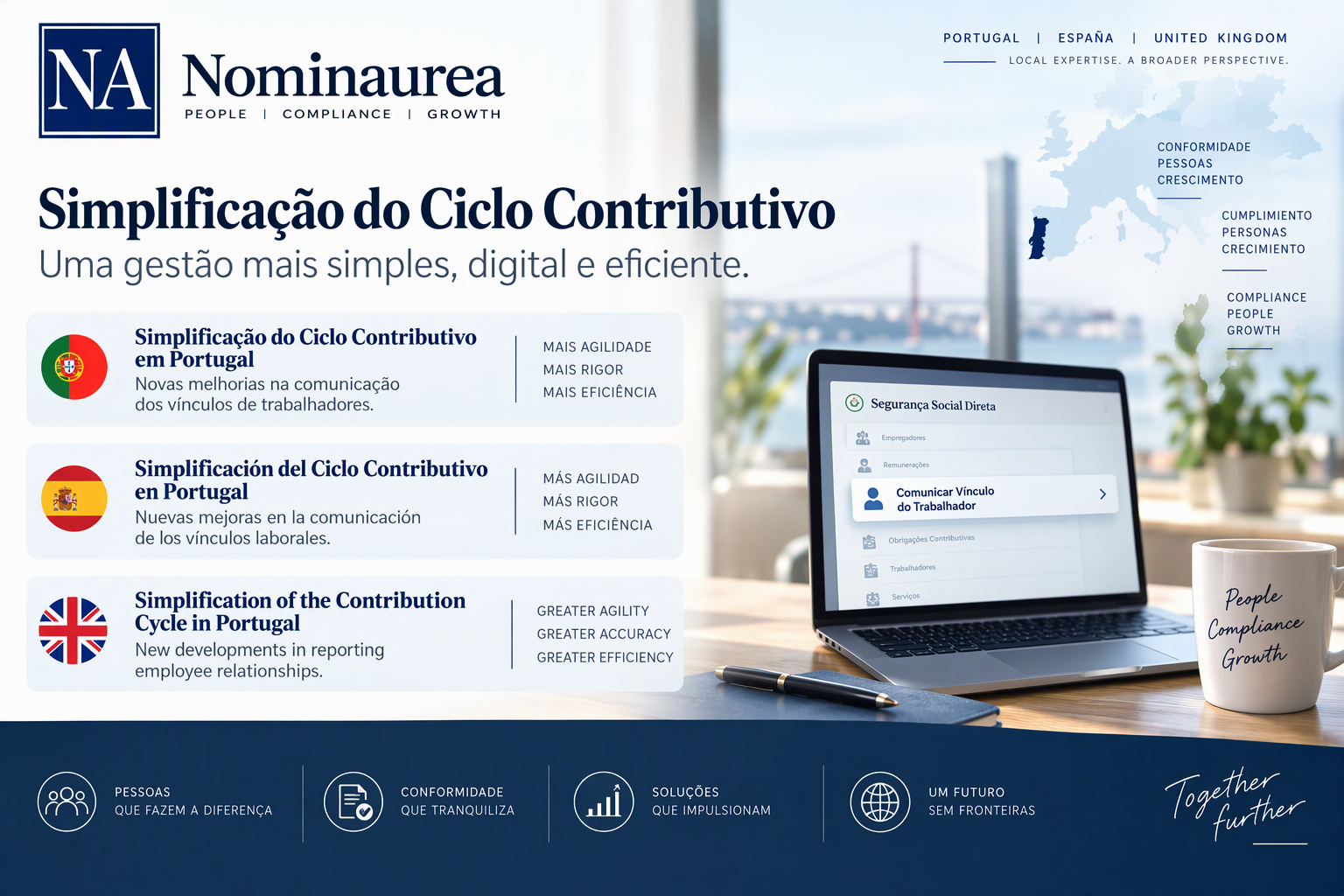
One of the key operational developments concerns the “Comunicar Vínculo do Trabalhador” functionality.
Previously, certain information could not be fully reported when an employee was first registered. Employers or their payroll service providers therefore had to access and update the employee’s employment record at a later stage.
The improvements are intended to allow more information to be recorded at a single point in time, making the employee registration process more comprehensive and reducing subsequent administrative work.
1. Identification of the Collective Bargaining Agreement
One of the improvements is the possibility of indicating, when reporting the employment relationship, whether an employee is covered by a Collective Bargaining Agreement (Convenção Coletiva de Trabalho – CCT) and immediately entering the corresponding code.
This is particularly relevant because important employment-related information can now be associated with the employee from the moment they join the company.
For organisations with different professional categories, workplaces or applicable collective agreements, this can also contribute to greater accuracy and consistency in the information recorded.
2. Additional Remuneration Components in the Initial Registration
Another important development concerns remuneration.
Previously, the initial communication was primarily focused on basic salary, requiring employers to update the employee’s record subsequently when other remuneration components applied.
Under the new approach, the initial communication can provide a more comprehensive picture of the employee’s permanent remuneration components.
In practical terms, where an employee’s agreed remuneration package is not limited to basic salary, the relevant information can be correctly recorded from the beginning of the employment relationship.
3. Fewer Subsequent Updates
This change has a particularly important practical benefit for HR, payroll and accounting teams: less duplication of administrative work.
The more complete the information provided when an employee is first registered, the less need there should be to access the employment record later to add information that was already known when the employee joined the company.
At the same time, this should help reduce the risk of discrepancies between the employment contract, payroll processing and the information reported to Social Security.
Data Quality Becomes Even More Important
Automation does not remove employers’ responsibilities.
On the contrary, in a system where contribution calculations increasingly rely on information already held by Social Security, the quality and accuracy of the underlying data become essential.
Employers should therefore verify information relating to existing employment relationships and ensure that the relevant records are accurate and up to date.
Processes such as employee onboarding, contractual amendments, changes in remuneration and other events with an impact on social security contributions will require careful control.
Incorrect information at the outset can subsequently affect contribution calculations and require employers to make corrections or carry out additional checks.
2026: A Transition Year
Companies operating in Portugal should also pay particular attention to the implementation timetable.
The transition to the Simplification of the Contribution Cycle takes place during 2026, ahead of the broader mandatory application of the new model from 1 January 2027.
Businesses should therefore use this transition period not only to understand the new functionalities but also to review their internal procedures relating to:
- employee registrations and terminations;
- updates to employment relationships;
- social security contribution classifications;
- permanent and variable remuneration components;
- payroll processing;
- verification of information registered with Social Security;
- validation of contribution obligations generated under the new model.
From Reporting to Validation
Perhaps the most important aspect of the SCC is the change in the underlying approach to contribution compliance.
The system is moving from a model largely based on the periodic reporting of information towards one in which a significant part of the contribution process is calculated using information already available, with employers being responsible for validating, correcting or supplementing that information whenever necessary.
This increased automation may reduce administrative work and improve predictability, but it also requires greater accuracy in internal HR and payroll processes.
Put simply: simplifying monthly reporting makes it even more important to get the information right from the outset.
Conclusion
The development of the employee relationship reporting functionality forms part of a wider transformation in the relationship between employers and Social Security in Portugal.
The possibility of providing more complete information from the outset, including the applicable Collective Bargaining Agreement (CCT) and the employee’s different permanent remuneration components, should improve the quality of employment records and reduce the need for subsequent administrative intervention.
With the transition to the Simplification of the Contribution Cycle taking place during 2026 and mandatory implementation scheduled from 1 January 2027, businesses should use this period to review their procedures, check existing employee records and ensure consistency between employment contracts, payroll data and the information registered with Social Security.
The overall aim is a contribution management system that is simpler, more digital and more automated, while ensuring that the underlying information is accurate from the outset.
How Can Nominaurea Help?
Nominaurea can support businesses throughout this transition, helping ensure that the changes introduced by the Simplification of the Contribution Cycle are correctly incorporated into their administrative, employment and payroll processes.
Our team can assist with:
- reviewing employee relationships and the information currently registered with Social Security;
- checking the remuneration components used for payroll processing;
- reviewing the correct application of the relevant Collective Bargaining Agreements (CCTs);
- preparing for and supporting the transition to the Simplification of the Contribution Cycle;
- adapting Payroll and Human Resources procedures to the new model;
- reviewing and validating social security contribution obligations;
- identifying and correcting potential inconsistencies between employment contracts, payroll records and information reported to Social Security;
- providing ongoing support with employment and social security compliance in Portugal.
At a time of significant change, preparing internal processes in advance can help businesses not only comply with the new requirements but also take full advantage of the greater simplification and automation offered by the new model.
At Nominaurea, we closely monitor developments in employment, payroll and social security obligations in Portugal, helping businesses turn regulatory and administrative changes into simpler, safer and more efficient processes.