

A new way to share Social Security documents
Until now, whenever an organisation required a declaration issued by Social Security, the procedure often involved the citizen acting as an intermediary: obtaining the document through the platform and then forwarding it to the interested party.
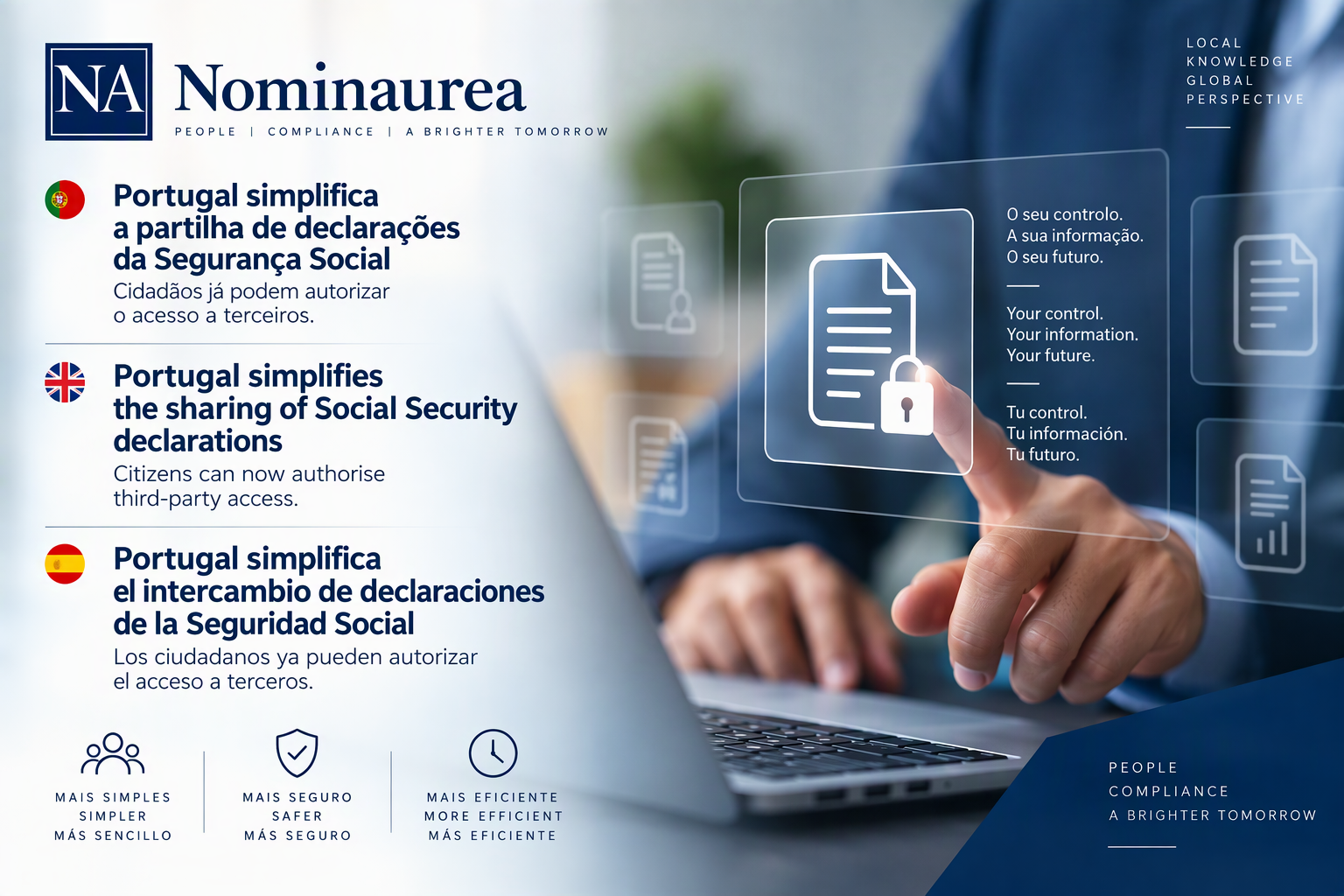
The new functionality introduces a different approach. Instead of acting as an intermediary in the transmission of the document, the citizen can allow an authorised third party to directly access the relevant declaration made available through Social Security.
The third party may be either an individual or a legal entity, including a company, service provider or organisation.
In practice, this can be particularly useful whenever a Social Security declaration is required as part of a procedure involving another organisation, eliminating some of the successive steps involved in obtaining and transmitting documents.
How does it work?
The functionality provides different ways of initiating access.
An organisation may request access to a declaration. The citizen then receives the request and decides whether to authorise it. Access is not automatically granted simply because a third party has submitted a request; it remains dependent on the holder’s authorisation.
Alternatively, citizens may take the initiative and grant access themselves, without having to wait for the organisation to submit a prior request.
Within Social Security Direct, access is managed through the Declarations area, using the option for requesting and managing access to declarations. When creating a new authorisation, citizens identify whether they wish to grant access to an individual or a legal entity and provide the relevant identification details.
One particularly important aspect is the requirement to indicate the purpose of the authorisation. The authorised person or organisation may only use the document and the associated data within the scope of the declaration for which access has been granted.
Citizens remain in control of their information
Simplification does not mean granting unrestricted access to all the information available through Social Security Direct.
On the contrary, authorisation is granted on a declaration-by-declaration basis. Before granting access, citizens should also review the declaration and verify the document issued.
It is also possible to establish the validity of the authorisation for a specific number of days or to define an expiry date.
This means that information sharing can be tailored to the specific need that gave rise to the request, without requiring citizens to provide indiscriminate access to other information contained within their personal area.
Less document circulation, greater administrative efficiency
This change is particularly relevant because it transforms a process traditionally based on the circulation of documents into a digital authorisation to access information.
Consider, for example, an organisation that requires a particular Social Security declaration in order to complete a procedure. Instead of the citizen obtaining the document and subsequently forwarding it, they may authorise the organisation to access the required declaration for a defined period.
For individuals, businesses and professionals involved in administrative procedures, this development can result in simpler document management and fewer steps when providing the necessary supporting documentation.
Authorising access does not mean losing control
This is perhaps the most important aspect of the new functionality.
Authorising a third party does not mean giving them unrestricted access to the citizen’s Social Security Direct account. The system allows citizens to select the declarations covered by the authorisation and determine how long that authorisation will remain valid.
Identification of the authorised party is also important. For an individual, information such as their NISS or NIF and date of birth is used. In the case of a legal entity, the citizen identifies the organisation using its respective NISS or NIF.
Once the authorisation has been granted, the organisation is notified through the Social Security Portal’s messaging area.
This approach seeks to reconcile two objectives that are not always easy to combine: administrative simplification and control over the sharing of personal information.
A development that businesses and professionals should follow closely
The significance of this change goes beyond simply introducing another option within Social Security Direct.
As administrative procedures increasingly move into digital environments, companies, accountants, HR departments and other professionals who regularly interact with Social Security need to adapt their own internal processes.
Whenever a Social Security declaration needs to be requested from an individual, it may now be appropriate to consider whether the process can be handled through this authorisation mechanism, reducing unnecessary document circulation.
At the same time, an essential principle should continue to apply: only the information genuinely required for the relevant procedure should be requested, and only for as long as necessary for its intended purpose.
Conclusion
The possibility of authorising third parties to access declarations represents another step forward in the digital transformation of public services in Portugal.
For citizens, it means being able to share certain declarations more directly while retaining the ability to decide who has access, which declaration they may access and for how long.
For businesses and professionals, it provides an opportunity to review procedures that still depend on the manual exchange of documents and to make greater use of digital mechanisms that can simplify administrative processes.
More than simply reducing paperwork, this change highlights an important development: a move from sending documents to managing authorisations for access to information.
How can Nominaurea help?
The increasing digitalisation of administrative obligations and Social Security procedures requires companies and professionals to keep pace not only with legislative changes, but also with new functionalities introduced within public-sector platforms.
Nominaurea supports its clients in managing employment, administrative and Social Security obligations, helping businesses understand these developments and incorporate them into their day-to-day procedures.
Our aim is to turn technical and administrative changes into simpler, safer and more efficient processes, reducing the administrative burden on businesses and allowing them to focus on their core activities.