

The new tax and accounting environment in Portugal in 2026
Portugal’s tax environment continues to evolve within a context of increasing digitalisation, automated reporting and enhanced tax authority oversight. In 2026, companies will face new requirements linked to accounting reporting, tax data validation and technological adaptation.
Recent measures aim to increase transparency, reduce reporting errors and accelerate the automatic exchange of information between public entities. For organisations, this creates a growing need for accounting accuracy, continuous updates and technological integration.
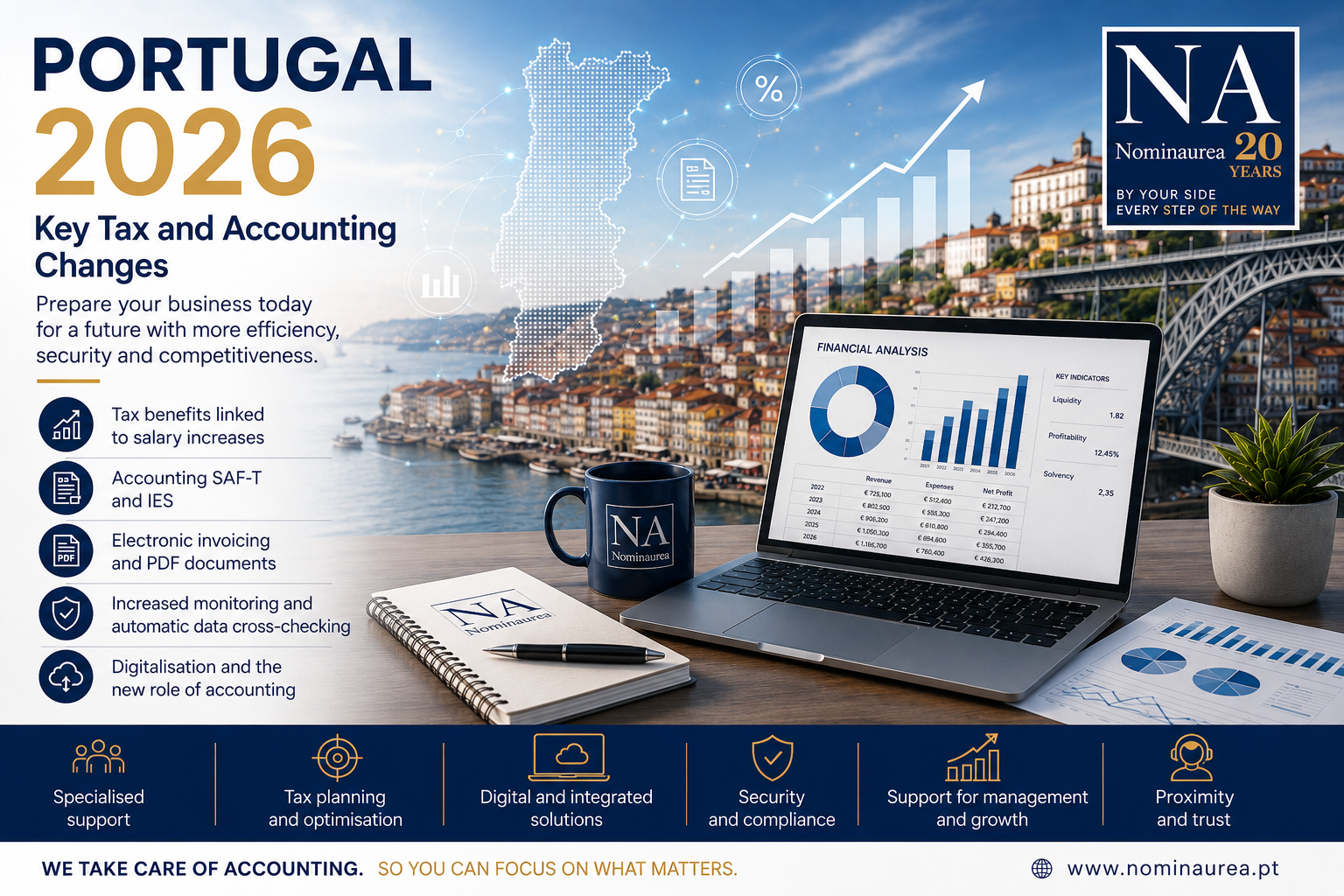
Tax incentives linked to salary increases
One of the measures with the greatest impact on businesses and employees is the continuation of tax incentives associated with productivity bonuses, performance-related payments and profit-sharing schemes.
In 2026, the partial personal income tax exemption on certain employee bonuses remains in force, if employers meet specific conditions relating to eligible salary increases.
This measure aims to encourage:
- Salary growth;
- Talent retention;
- Increased productivity;
- Improved business competitiveness.
For many companies, this represents an important opportunity to strengthen human resources policies while benefiting from associated tax advantages.
Accounting SAF-T and IES: preparation remains essential
Despite certain legislative postponements, the implementation of accounting SAF-T requirements continues to be one of the most significant tax transformations in recent years.
Companies should continue preparing for:
- Proper taxonomy structuring;
- Validation of accounting charts;
- Automated accounting reporting;
- Integration between management software and tax obligations;
- Preparation for the automatic pre-completion of IES submissions.
Although some obligations have once again been deferred, the direction of legislation is clear: accounting in Portugal will become increasingly digital, integrated and subject to automatic validation processes.
Electronic invoicing and PDF documents remain accepted
Another important measure is the continued acceptance of PDF invoices as valid electronic invoices for tax purposes.
This approach allows companies to maintain simpler and more flexible administrative processes while gradually adapting to more advanced structured electronic invoicing systems.
Even so, businesses should prepare for a future with greater document automation and stronger digital integration between suppliers, customers and the Tax Authority.
Increased monitoring and automatic data cross-checking
Technological developments within the Portuguese Tax Authority continue to strengthen the automatic cross-checking of information between:
- Tax returns;
- SAF-T files;
- Social Security records;
- Accounting records;
- Banking and financial information;
- IES data.
This environment significantly increases the importance of:
- Well-organised accounting systems;
- Regular reconciliations;
- Correct accounting classifications;
- Timely compliance with reporting obligations.
Errors that were previously difficult to detect can now easily be identified through automated data analysis systems.
Digitalisation and the new role of accounting in Portugal
The accounting profession itself is also undergoing a profound transformation. Accountants are no longer seen solely as operational professionals and are increasingly taking on a strategic role within businesses.
In 2026, organisations require partners capable of:
- Interpreting tax changes;
- Supporting management decisions;
- Optimising financial processes;
- Ensuring compliance;
- Implementing digital solutions;
- Reducing tax risks.
The digital transformation of accounting is no longer a future trend — it is already a present-day reality.
Conclusion
The year 2026 marks another decisive step in the modernisation of tax and accounting systems in Portugal. Companies that invest early in accounting organisation, digitalisation and tax planning will be better prepared to face upcoming legal and operational challenges.
Beyond simply meeting obligations, the real objective should be to transform accounting into a strategic tool for growth, control and long-term business sustainability.
In an environment of constant legislative change, specialised technical support is becoming increasingly important to ensure security, efficiency and competitiveness.
How Nominaurea Can Help
Nominaurea supports businesses in Portugal through specialised services including:
- Accounting and tax support;
- Financial consultancy;
- Compliance and reporting obligations;
- Payroll processing;
- Support for accounting digitalisation;
- Internal procedure implementation;
- Tax planning and optimisation;
- Ongoing monitoring of legislative changes.
With a modern, client-focused and results-driven approach, Nominaurea helps businesses transform accounting into a genuine management and sustainable growth tool.