

The Patronage Regime in Portugal
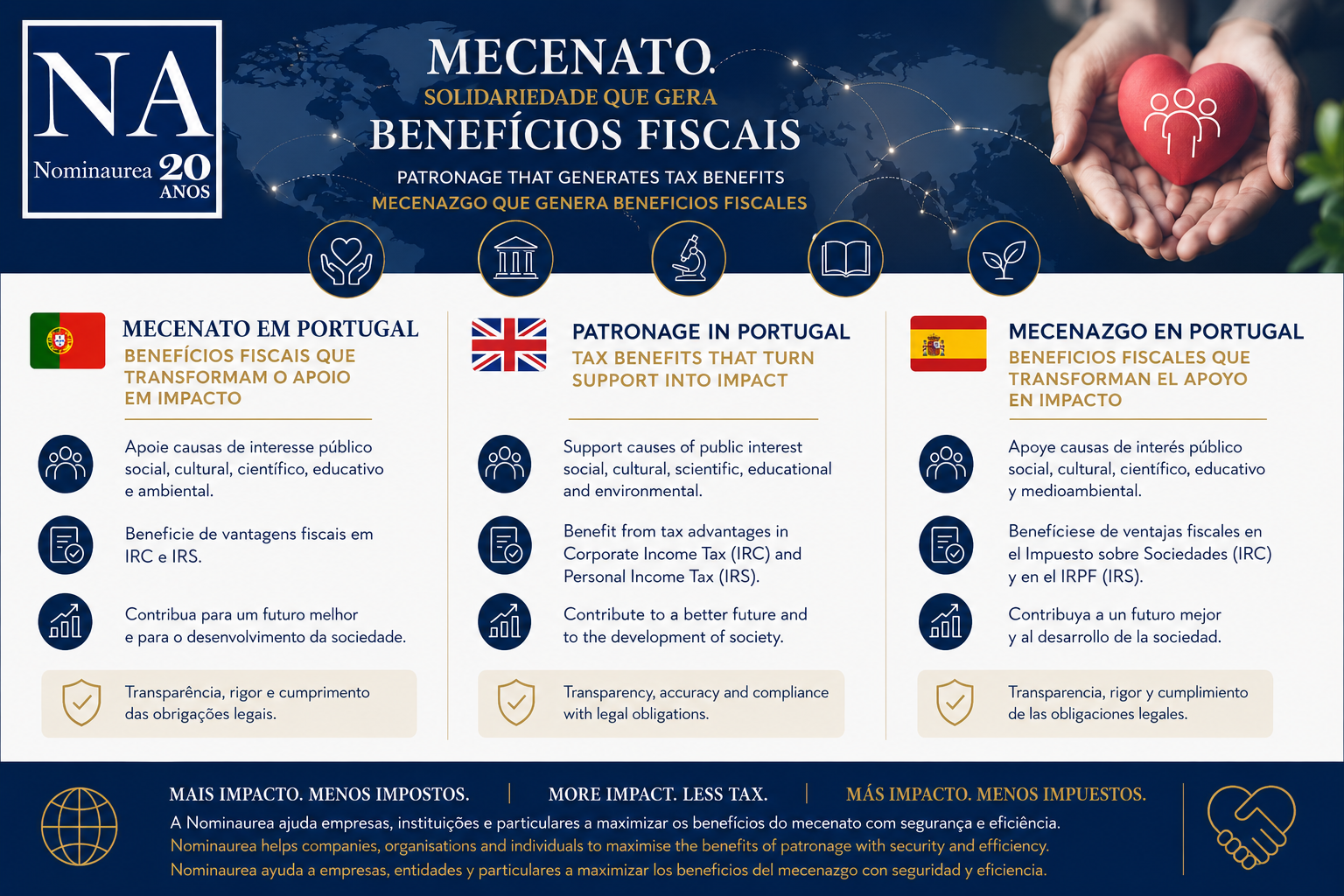
Patronage represents a form of voluntary support for organisations carrying out activities recognised as being in the public interest. This support may take the form of cash donations, donations of assets, or the free provision of services, provided that no commercial or financial consideration is received by the donor.
In Portugal, the regime is governed by the Tax Benefits Statute, which establishes the conditions under which donations may qualify for favourable tax treatment.
The legislator’s objective is to encourage the participation of civil society and the business community in financing projects of collective interest, strengthening areas that are fundamental to the country’s economic, social and cultural development.
What is Considered a Donation?
For tax purposes, only contributions made without any form of consideration that creates a commercial or financial obligation are regarded as donations.
This means that a company cannot benefit from the patronage regime when a payment effectively corresponds to advertising, sponsorship or the purchase of services. In such cases, the transaction is considered a normal commercial operation rather than an eligible donation.
Donations may be made in the form of:
- Cash;
- Movable or immovable property;
- Equipment;
- Rights;
- Free provision of services.
Who Can Benefit from Donations?
The Tax Benefits Statute provides for a wide range of eligible beneficiary entities, including:
- Private Social Solidarity Institutions (IPSS);
- Foundations;
- Non-profit associations;
- Cultural organisations;
- Museums and libraries;
- Universities and scientific research institutions;
- Public bodies;
- Organisations carrying out environmental, educational or sporting activities;
- Innovation and scientific research projects.
The eligibility of the beneficiary organisation is one of the most important aspects in ensuring access to the tax benefits associated with patronage.
Tax Benefits for Companies
Companies making donations that qualify under the patronage regime may deduct those expenses for Corporate Income Tax (IRC) purposes when determining their taxable profits.
In many cases, legislation allows the value of the donation to be considered at an amount higher than that actually donated, through the application of tax enhancements that increase the resulting benefit.
These enhancements vary according to the nature of the beneficiary organisation and the type of activity being supported and can be particularly attractive in the social, cultural and scientific sectors.
As a result, the effective cost of the support provided by the company becomes significantly lower than the value of the donation itself, encouraging investment in projects of public interest.
Tax Benefits for Individuals
Individual taxpayers may also benefit from tax advantages when making donations to eligible organisations.
The donated amounts may be considered for tax deduction purposes, within the limits established by law.
In addition to the tax benefit, this opportunity enables individuals to contribute actively to social, cultural, scientific and environmental causes, reinforcing their role within the community.
Scientific and Cultural Patronage
In recent years, legislators have strengthened incentives aimed at scientific and cultural patronage, recognising their impact on sustainable development and the enhancement of national heritage.
Scientific patronage supports research projects, technological innovation and the advancement of knowledge.
Cultural patronage seeks to promote artistic activities, preserve historical heritage, support cultural production, festivals, museums, libraries and other initiatives that contribute to the country’s cultural wealth.
These categories frequently benefit from more favourable enhancement regimes, reflecting the strategic importance of these areas for Portugal.
Obligations of Beneficiary Entities
Entities receiving donations under the patronage regime must comply with various legal and tax obligations.
These include:
- Issuing receipts or certificates for donations received;
- Identifying the applicable legal framework;
- Maintaining updated records of donors;
- Complying with reporting obligations before the Tax Authority.
Failure to comply with these obligations may jeopardise the donor’s tax benefit and create tax contingencies for the beneficiary organisation.
Key Considerations Before Donating
Before donating with the expectation of obtaining a tax benefit, it is advisable to verify:
- Whether the beneficiary organisation is properly covered by the patronage regime;
- Whether the support involves no commercial consideration;
- Whether the documentation issued complies with legal requirements;
- Whether payment is made through methods that allow the donor to be identified;
- Whether there are any specific limits or conditions applicable to the intended tax benefit.
A prior assessment helps avoid tax risks and ensures the correct use of the available incentives.
Conclusion
The patronage regime is an important instrument of tax policy and corporate social responsibility in Portugal. By allowing companies and individuals to support causes of public interest while benefiting from associated tax incentives, it promotes greater participation by society in the country’s social, cultural, scientific and environmental development.
In a context where sustainability and social responsibility are becoming increasingly important, patronage offers an opportunity to combine a positive impact on the community with efficient tax management.
How Nominaurea Can Help
Nominaurea provides specialised support in the analysis and tax treatment of patronage operations, helping companies, associations and foundations maximise the benefits available under the Tax Benefits Statute.
Our services include:
- Verification of the eligibility of beneficiary organisations;
- Analysis of applicable Corporate and Personal Income Tax benefits;
- Support with donation documentation;
- Assistance with reporting obligations;
- Specialised tax consultancy regarding tax incentives and tax planning.
If you are looking to implement a tax-efficient social responsibility strategy or ensure the correct tax treatment of your donations, the Nominaurea team is ready to assist you.
The patronage regime is established under Chapter X of the Tax Benefits Statute, which regulates the concept of donations, benefits available to companies and individuals, scientific and cultural patronage, and the obligations of beneficiary entities.