

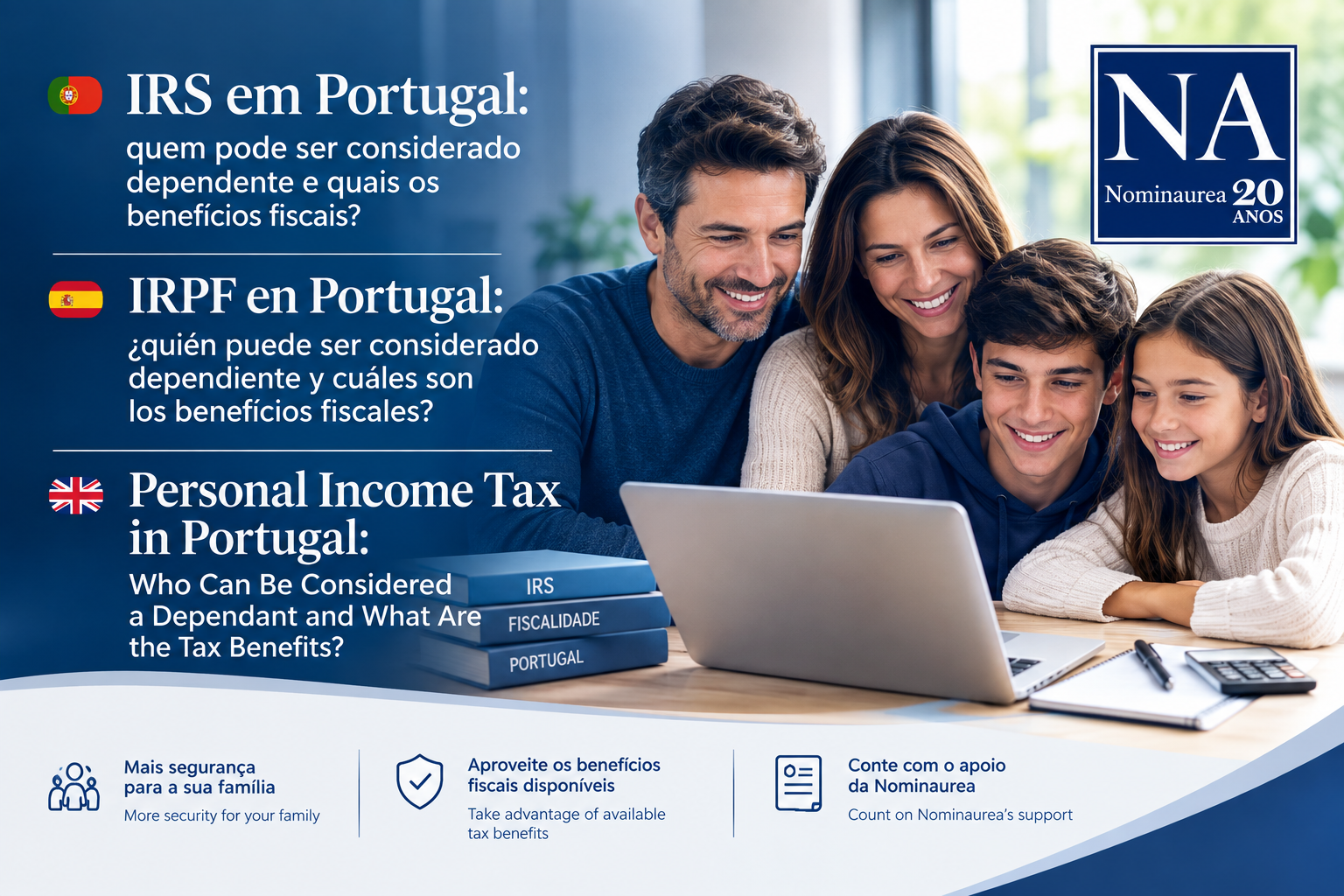
In 2026, an adult child may continue to be considered a dependant, under certain conditions, until the age of 25, provided that the requirements established under the Personal Income Tax Code regarding age and income are met. For cases covered by this regime, the income threshold is linked to the Minimum Monthly Guaranteed Remuneration (RMMG).
Who is considered a dependant for Personal Income Tax purposes?
For Personal Income Tax purposes, the concept of a dependant does not necessarily correspond to the idea of someone who has no income or who is financially dependent on their parents.
The Personal Income Tax Code establishes specific criteria to determine who may be included in a household as a dependant.
In general terms, the following may be considered dependants:
- Children, adopted children and stepchildren who are minors and not legally emancipated;
- Minors who are under guardianship;
- Adult children, adopted children and stepchildren who meet certain age and income requirements;
- Adult children, adopted children, stepchildren and persons under guardianship who are unable to work and obtain means of subsistence, under the conditions established by law;
- Certain civil godchildren, where the legally established conditions are met.
Dependants must be identified in the Personal Income Tax return using their respective Tax Identification Number (NIF).
What happens when a child turns 18?
Turning 18 does not automatically mean that a child ceases to be considered a dependant for Personal Income Tax purposes.
This is one of the situations that raises the most questions for families.
An adult child may continue to be part of their parents’ household for tax purposes, provided that the requirements established in the Personal Income Tax Code are met.
In particular, adult children, adopted children and stepchildren, as well as individuals who were under guardianship until reaching adulthood, may continue to be considered dependants provided that:
- They are no older than 25;
- Their annual income does not exceed the legally established threshold;
- The other conditions established in the Personal Income Tax Code are met.
Therefore, reaching adulthood alone does not immediately result in the loss of dependant status.
What is the income threshold for an adult dependant?
This is one of the most relevant issues for families with adult children who start working.
The income threshold applicable to certain adult dependants is linked to the Minimum Monthly Guaranteed Remuneration.
In 2026, the RMMG applicable in mainland Portugal is €920 per month. Considering the threshold of 14 times the RMMG, the corresponding annual reference amount is €12,880.
Therefore, for an adult child to continue to be considered a dependant under this regime, it is necessary to verify, among other requirements, that their annual income does not exceed the applicable legal threshold.
However, each individual situation and the nature of the income received should be analysed, as determining the income relevant for tax purposes may require a more detailed assessment.
What if the child starts working?
Starting a professional activity does not necessarily mean that the child immediately ceases to be considered a dependant.
For example, a university student may start working during the year and still meet the requirements to remain part of their parents’ household for tax purposes.
What matters is whether the legal requirements are met at the end of the tax year, particularly those relating to age and income.
Conversely, if the income exceeds the legal threshold or the other required conditions are no longer met, the child may cease to qualify as a dependant.
This analysis is particularly important when a young person starts working in the middle of the year, undertakes paid internships, enters into an employment contract or starts a self-employed activity.
Until what age can a child be considered a dependant?
For adult children who fall within the general regime applicable to young dependants, the age limit is generally 25 years.
This means that a young person may continue to be considered a dependant after turning 18, but not indefinitely.
For Personal Income Tax purposes, the relevant personal and family circumstances are generally those existing on 31 December of the tax year.
Therefore, when a child reaches a certain age during the year or starts working, it is important to analyse the specific circumstances taking into account the situation at the end of the relevant tax year.
What happens after the age of 25?
Once the age of 25 has been exceeded, a child will generally no longer qualify as a dependant under the regime applicable to adult children who are studying or whose income remains within the legal threshold.
However, the Personal Income Tax Code provides for a specific situation.
Adult children, adopted children, stepchildren and persons under guardianship who are unable to work and obtain means of subsistence may continue to be considered dependants, provided that the legally established requirements are met.
Therefore, age should not be considered in isolation: the personal and financial circumstances of the household member must also be taken into account.
Dependants in cases where parents are separated
Separation and divorce situations require particular attention.
A dependant cannot simply be considered as belonging to two households simultaneously.
Where parental responsibilities are jointly exercised by taxpayers who do not belong to the same household, the Personal Income Tax Code establishes specific rules for determining which household the dependant belongs to.
In particular, the residence established as part of the arrangements governing parental responsibilities must be taken into account. Where no residence has been established or it is not possible to determine the habitual residence, the dependant’s tax address on 31 December may be relevant in certain circumstances.
In cases of alternating residence, there are also specific rules concerning the allocation of deductions and the reporting of expenses.
It is therefore essential to ensure that information concerning the household, parental responsibilities and the dependant’s residence is correctly reflected on the Portuguese Tax Authority’s online portal.
What are the tax benefits of having dependants?
Having dependants can have a significant impact on Personal Income Tax.
One of the main consequences is the possibility of benefiting from the tax deduction available for children and other qualifying dependants.
For 2026, the Personal Income Tax Code provides for a basic deduction of €600 per dependant, without prejudice to the additional amounts applicable depending on the dependant’s age and certain family circumstances.
Specific rules also apply to younger children and to households with more than one dependant.
In addition to this deduction, expenses relating to dependants may contribute to other tax deductions, including eligible healthcare and education expenses, provided that the relevant legal and tax requirements are met.
For this reason, keeping the dependant’s Tax Identification Number correctly registered and monitoring the expenses reported to the Portuguese Tax Authority is essential to avoid losing available tax benefits.
The importance of keeping household information updated
Changes in household composition must be reported to the Portuguese Tax Authority within the legally established deadlines.
The birth of a child, adoption, changes in family circumstances, divorce, a change in the child’s residence or other relevant changes may have an impact on Personal Income Tax.
Outdated information may also prevent or affect the use of the automatic tax return system or result in discrepancies in the tax return.
For this reason, before filing the Personal Income Tax return, it is advisable to check:
- Who belongs to the household;
- Which dependants should be declared;
- The Tax Identification Numbers of the dependants;
- The children’s residence arrangements;
- Healthcare and education expenses;
- Income earned by adult children;
- Whether parental responsibilities are shared;
- The information available on the Portuguese Tax Authority’s online portal.
Conclusion
Being considered a dependant for Personal Income Tax purposes does not simply mean being under 18.
In Portugal, the legislation allows certain children, adopted children, stepchildren and other qualifying family members to continue to be considered dependants after reaching adulthood, provided that specific requirements relating, among other factors, to age, income and personal circumstances are met.
For adult children, the 25-year age limit and the income threshold linked to the RMMG are particularly relevant. In 2026, with an RMMG of €920, the threshold corresponding to 14 times that amount is €12,880 per year in mainland Portugal.
A correct assessment of the family’s circumstances and of the income earned by dependants can make a significant difference to the amount of Personal Income Tax payable or refundable. Therefore, it should not be assumed that a child automatically ceases to be a dependant upon turning 18 or starting to work.
How can NOMINAUREA help?
NOMINAUREA supports individuals, entrepreneurs and companies with their tax obligations and with the correct assessment of situations that may have an impact on Personal Income Tax.
We can assist with:
- Analysing household composition for tax purposes;
- Verifying the tax status of dependants;
- Assessing situations involving adult children and students;
- Reviewing expenses and tax deductions related to dependants;
- Assisting with the preparation and filing of Personal Income Tax returns;
- Analysing situations involving separation or alternating residence of dependants;
- Clarifying tax matters related to income tax returns.
Proper preparation of your Personal Income Tax return starts before the return is filed.
NOMINAUREA is available to help ensure that your tax situation is assessed rigorously and in accordance with the legislation in force.