


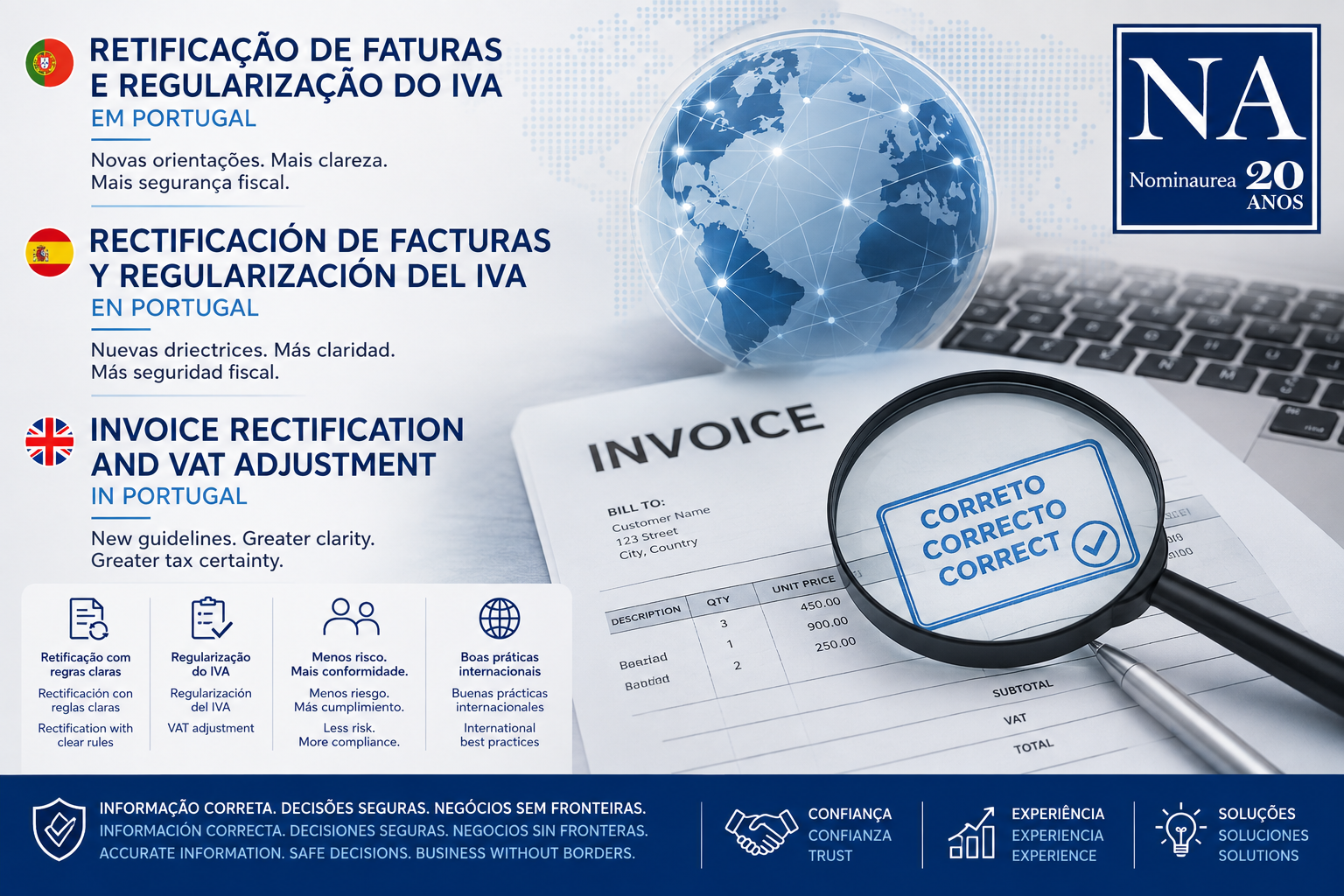
These guidelines are particularly relevant in a context of increasing digitalisation of invoicing and greater scrutiny of the information reported to the Portuguese Tax and Customs Authority (AT), requiring companies to review their internal invoicing, accounting and tax compliance procedures.
Invoice Rectification and VAT Adjustments: A Matter Requiring Attention
Issuing an invoice containing incorrect information is a relatively common situation in business activities. An incorrect tax identification number, an inaccurate description, an error in the price, an incorrectly applied VAT rate or a subsequent change to the transaction amount may require different procedures.
The key point is that not all invoice errors should be treated in the same way.
Article 78 of the Portuguese VAT Code establishes that, where, after an invoice has been issued, the taxable amount or tax is amended, the rules applicable to the corresponding adjustment must be followed. In the case of inaccurate invoices that have already been recorded, correction is mandatory where less tax than due has been charged and optional where more tax than due has been charged, with the latter being subject to a specific time limit.
It is precisely in this context that the new Circular Letter No. 25120 becomes particularly relevant.
1. Formal Errors: When VAT Is Not Affected
One of the main clarifications concerns so-called purely formal errors.
Where the error contained in an invoice does not affect the taxable amount or the VAT charged, the procedure should differ from that applicable to an actual VAT adjustment.
This may include, for example, certain errors relating to the identification of the customer, such as an incorrect tax identification number, or inaccuracies in descriptive elements of the transaction.
In such cases, the procedure may, under certain circumstances, involve the cancellation of the incorrect invoice and the issuance of a new invoice containing the correct information, without this, in itself, resulting in a new effective charge of VAT.
This distinction is particularly important because it prevents the indiscriminate use of credit notes to correct situations that do not involve any change to the tax.
2. When the Taxable Amount or VAT Is Changed
A different situation arises when an error or subsequent change affects the taxable amount or VAT charged.
In these cases, the correction must be made through the appropriate document, namely a credit note or a debit note, depending on the nature of the adjustment.
For example, if a company invoices a service for an amount higher than the amount actually due, the reduction in the transaction value should be formalised through a corrective document that clearly identifies the original invoice and the amount being adjusted.
Similarly, where the taxable amount or VAT initially invoiced is lower than the amount actually due, the corresponding correction must be made, ensuring that the appropriate VAT is charged and properly reported.
The objective is to ensure a clear link between:
- the original invoice;
- the corrective document;
- the accounting records;
- the VAT charged or adjusted;
- the information reported to the Tax Authority.
3. VAT Adjustments: The Procedure Does Not End with Issuing a Credit Note
One of the main risks associated with invoice rectification is assuming that issuing a credit note, by itself, resolves the entire tax matter.
It does not.
Whenever a correction involves a change to VAT, it is necessary to assess who is required to make the adjustment, in which period it should be made, which return should be used and which supporting documentation must be retained.
Article 78 of the Portuguese VAT Code provides for different adjustment situations, including the cancellation or reduction of the taxable amount, returns, discounts, rebates and inaccurate invoices.
Consequently, the treatment of a credit note must be coordinated with the accounting treatment and the relevant periodic VAT return.
4. The Importance of the Treatment by Both Supplier and Customer
VAT adjustments may affect both the issuer of the invoice and its recipient.
Where a credit note reduces the VAT initially charged by the supplier, this change may also require a corresponding adjustment to the VAT previously deducted by the customer.
It is therefore essential to ensure consistency between both parties to the transaction and to maintain documentation demonstrating the origin and basis of the adjustment.
In certain situations, the adjustment also requires the customer to be informed or to acknowledge the correction, particularly where the adjustment concerns VAT that had previously been deducted.
Proper coordination between supplier and customer significantly reduces the risk of discrepancies between the information recorded in their respective accounting records and tax returns.
5. Cancelling an Invoice Should Not Be Confused with a VAT Adjustment
Another issue requiring particular attention is the distinction between invoice cancellation and VAT adjustment.
An invoice may need to be cancelled because it contains a formal error, without any actual change to the VAT. In other situations, the transaction originally invoiced may have been effectively amended, cancelled or reduced, resulting in tax consequences.
This distinction is important because it determines the appropriate documentary, accounting and reporting procedures.
Furthermore, where the invoice has already been reported to the Tax Authority, the company must ensure that the reported information is properly corrected, avoiding discrepancies between the documents issued and the information available to the Tax Authority.
6. Impact on Invoicing Systems and Reporting to the Tax Authority
The increasing digitalisation of invoicing makes the correct treatment of rectifications even more important.
Companies should check that their systems are able to:
- correctly cancel issued documents;
- issue corrective documents properly linked to the original invoices;
- maintain an audit trail of amendments;
- ensure the correct reporting of documents to the Tax Authority;
- properly reflect transactions in the accounting records;
- identify VAT adjustments for the purposes of the periodic VAT return.
The new framework therefore makes it advisable to review internal procedures and, where necessary, the configuration of invoicing and accounting systems.
This issue is even more relevant considering the changes introduced in 2026 to the periodic VAT return and the respective adjustment schedules.
7. Deadlines: An Aspect That Cannot Be Ignored
VAT adjustments are subject to specific rules and deadlines, which vary depending on the nature of the situation.
It is therefore essential to determine:
- what error or event gave rise to the correction;
- when that event occurred;
- whether the taxable amount has changed;
- whether the VAT amount has changed;
- who is responsible for making the adjustment;
- in which period it should be reported;
- whether a replacement periodic VAT return is required;
- what documentation must be retained as evidence.
The analysis should be carried out on a case-by-case basis, since an incorrect procedure may result in differences in VAT charged or deducted and, consequently, additional obligations towards the Tax Authority.
8. What Should Companies Do?
In light of these new guidelines, companies should take the opportunity to review their internal procedures.
It is advisable to establish clear rules for identifying and dealing with different types of errors, distinguishing from the outset between purely formal errors and situations that affect VAT.
Companies should also ensure that the teams responsible for invoicing, accounting and financial management are familiar with the applicable procedures and that there is effective coordination between these areas.
An internal policy for controlling credit notes and debit notes can be particularly useful, making it possible to document the reason for the correction, the original invoice, the impact on VAT and the accounting and reporting treatment adopted.
9. A New Reality for Corporate Tax Management
Circular Letter No. 25120 represents more than a simple update to administrative procedures.
Its application reinforces the need for companies to regard invoicing as an area directly connected with tax compliance and the quality of accounting information.
In an environment where invoice information is increasingly automated and subject to cross-checking, apparently minor errors can generate discrepancies between invoicing, accounting records, periodic VAT returns and the information available to the Tax Authority.
Prevention therefore becomes essential.
Conclusion
The new framework governing invoice rectification and VAT adjustments in Portugal requires companies to adopt a more structured approach.
The main message is straightforward: an incorrect invoice should not automatically be corrected by issuing a credit note. Before making a correction, it is necessary to identify the nature of the error, assess its impact on the taxable amount and VAT, and determine the appropriate documentary, accounting and tax procedure.
Correct application of these rules helps reduce tax risks, prevent discrepancies in the information reported to the Tax Authority and provide greater certainty in meeting VAT obligations.
For companies, this is also a good opportunity to review processes, update internal procedures and confirm that their invoicing and accounting systems are prepared to meet the new requirements.
How Can NOMINAUREA Help?
NOMINAUREA – Tax Consultancy and Accounting can support companies in analysing and implementing the procedures arising from the new rules on invoice rectification and VAT adjustments.
Our team can provide support in areas including:
- analysing errors and specific invoice rectification situations;
- defining the appropriate procedure for cancelling, correcting or issuing corrective documents;
- assessing the VAT impact of corrections;
- accounting treatment of credit notes and debit notes;
- identifying the VAT adjustments to be reported in the periodic VAT return;
- reviewing internal invoicing procedures;
- coordinating invoicing, accounting and tax compliance;
- monitoring legislative and administrative changes affecting companies.
In an increasingly digital and demanding tax environment, anticipating problems is always more efficient than correcting them afterwards.
NOMINAUREA is ready to help your company adapt its processes and ensure rigorous, efficient tax compliance tailored to the specific needs of your business.