

What is de minimis aid?
De minimis aid refers to public support granted to businesses in small amounts which, due to their limited value, are considered not to have a significant impact on competition or trade between EU Member States.
This framework stems from the rules established by the European Commission on State aid, aimed at ensuring fair competition within the internal market. However, it is recognised that low-value aid does not distort market functioning and can therefore be treated under a simplified regime.
De minimis aid has several distinguishing features:
- No prior notification to the European Commission is required
- Faster and simpler approval procedures
- Reduced administrative burden for public authorities and businesses
- Broad applicability across different types of incentives
In practice, de minimis aid may take various forms, including:
- Non-repayable grants
- Hiring incentives
- Training support
- Tax benefits (such as tax reductions or credits)
- Support for innovation, internationalisation or investment
Regardless of its form, such support is counted as de minimis aid whenever it falls within this framework.
A key aspect of de minimis aid is that it is not assessed in isolation but on a cumulative basis over time. In other words, eligibility is determined not only by the value of a single grant but by the total amount of de minimis aid received by a company over a three-year period.
👉 This means that:
- Even small amounts of aid may restrict access to future incentives
- It is essential to maintain accurate records of all aid received
- These limits must be closely monitored from an accounting and financial perspective
In summary, de minimis aid is a crucial economic policy tool, enabling businesses to access public funding more quickly and with less bureaucracy, while requiring careful monitoring of cumulative amounts and compliance with the applicable legal framework.
New maximum thresholds for 2024–2026
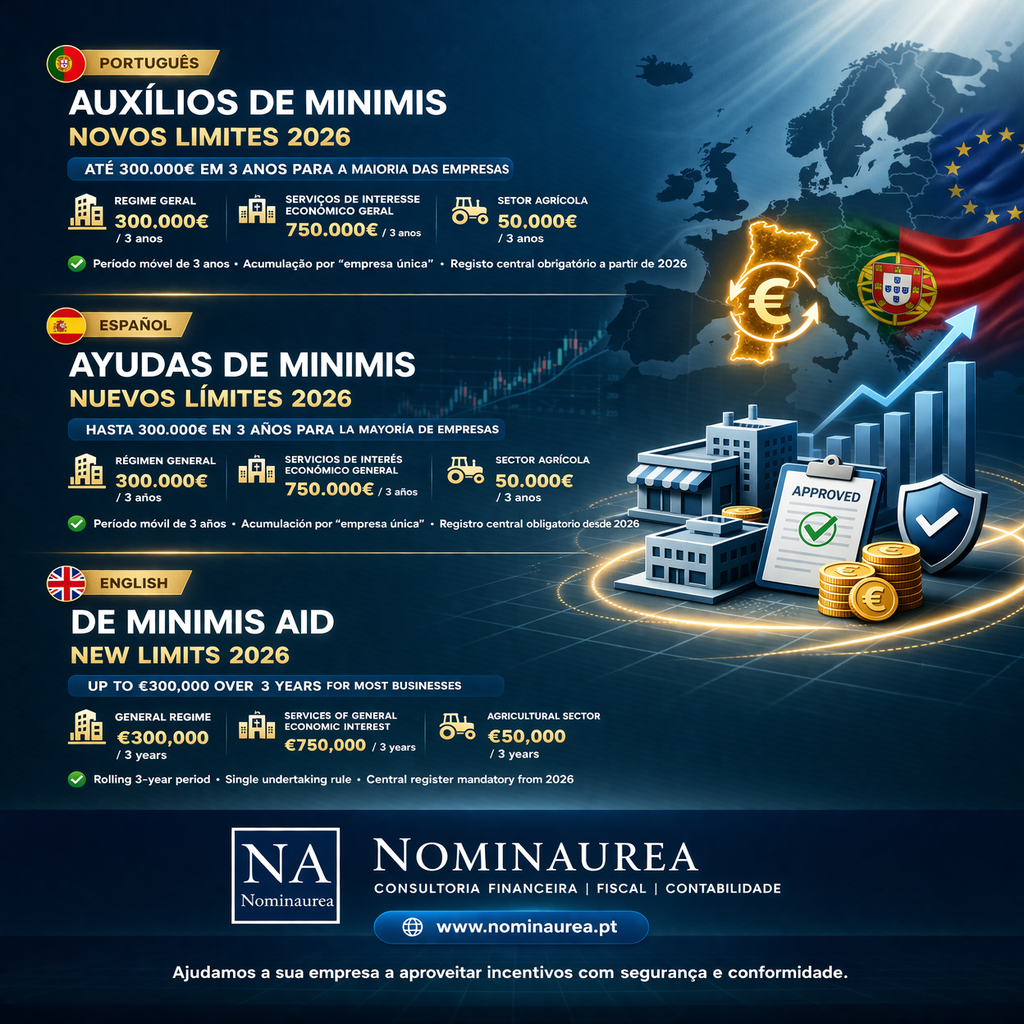
With the entry into force of the new EU framework, the following limits apply:
✔️ General regime (most sectors)
- €300,000 per undertaking
- Reference period: 3 years (rolling basis)
This represents a significant increase from the previous €200,000 limit.
✔️ Services of General Economic Interest (SGEI)
- €750,000 per undertaking over 3 years
Applicable to entities providing essential public services.
✔️ Agricultural sector
- €50,000 per undertaking over 3 years
This limit has been recently updated to reflect inflation and sector developments.
Accumulation rule
De minimis aid:
- Is calculated on the basis of a “single undertaking”
- Uses a rolling three-year period
- Must always remain within the applicable threshold
This means that each new aid granted requires checking the total received over the previous three years.
Mandatory central register
From 2026:
- Member States must maintain a central register of aid
- Public bodies must report the aid granted
This aims to:
- Reduce administrative burden
- Increase transparency
- Improve monitoring of thresholds
Practical implications for businesses
- Greater capacity to access public funding
- Need for strict monitoring of aid received
- Importance of accounting and tax oversight
- Strategic planning of incentive usage
Conclusion
De minimis aid continues to play a crucial role in business financing in Portugal.
With increased thresholds and new reporting requirements, it is essential for companies to manage these aids carefully, ensuring compliance and maximising available opportunities.
How Nominaurea can help
Nominaurea supports businesses in:
- Identifying available incentives and support schemes
- Monitoring de minimis thresholds
- Tax and financial planning
- Compliance and reporting obligations