

VAT and Credit memos in Portugal: What Has Changed?
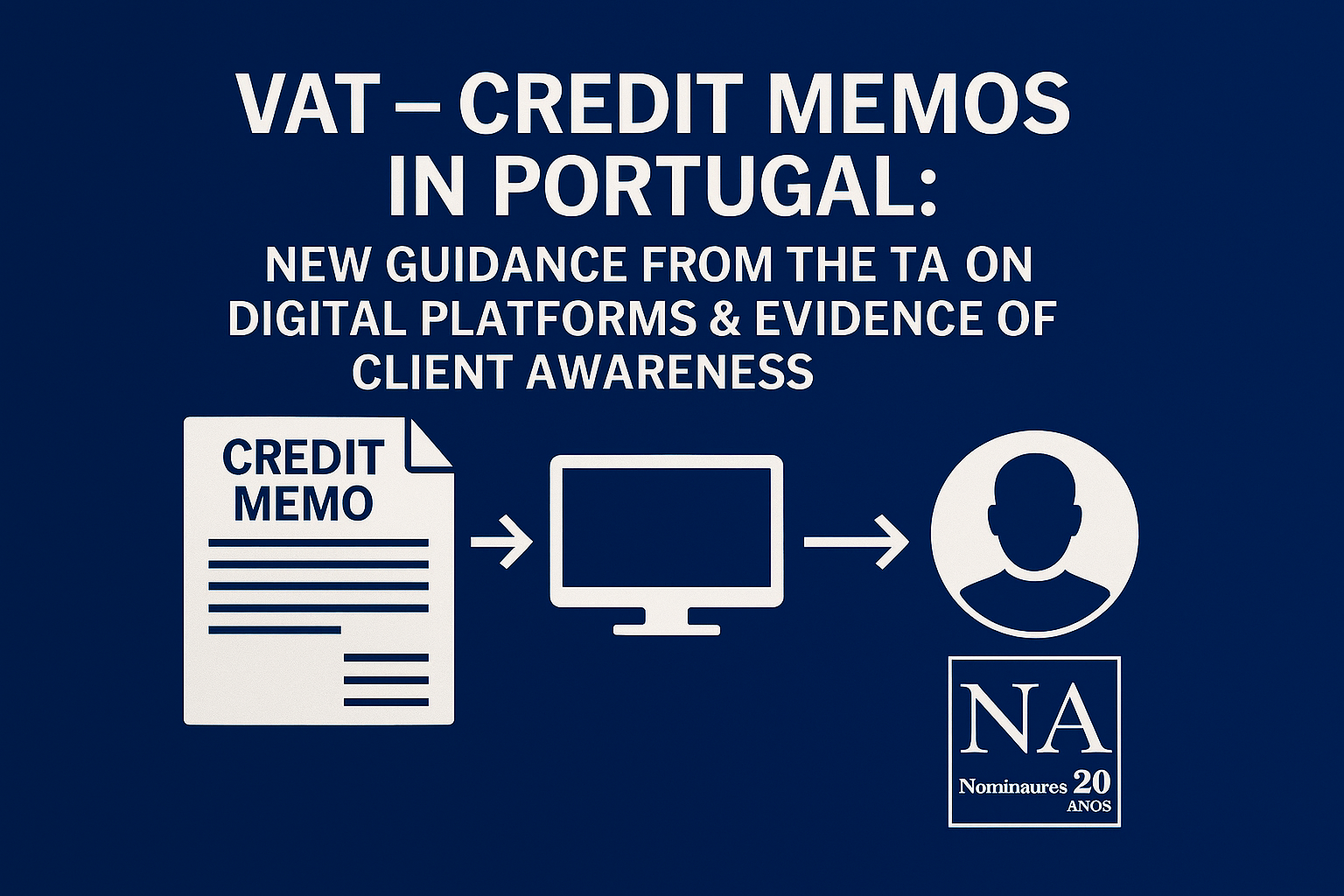
Credit memos play an essential role in VAT adjustments whenever there is a need to correct invoiced amounts, grant subsequent discounts, cancel transactions or make other commercial adjustments.
Under Article 78 of the Portuguese VAT Code, whenever VAT is adjusted downwards, the taxable person may only recover the VAT paid to the State if there is proof that the customer became aware of that adjustment.
For many years, the most common practice involved obtaining physical documents signed by the customer, such as:
- signed copy of the credit note;
- confirmation letter;
- return receipt;
- formal written communication.
However, the digital transformation of businesses and the growing use of electronic platforms raised doubts regarding the validity of digital evidence before the Portuguese Tax Authority.
The recent Binding Information specifically addresses and clarifies this issue.
The Position of the Portuguese Tax Authority
The Tax Authority analysed the case of a company using an electronic invoicing platform to make credit memos available to its customers.
The system allowed:
- automatic document delivery;
- tracking of opening and viewing activity;
- identification of the user accessing the document;
- recording of access date and time;
- retention of access history and tracking logs.
The key question was whether these elements were sufficient to demonstrate customer awareness of the credit note and therefore allow the VAT adjustment.
The Tax Authority’s response is highly relevant for the market.
The Portuguese Tax Authority acknowledged that electronic means may be considered valid and suitable, provided they ensure:
- traceability;
- effective proof of customer awareness;
- proper retention of documentary evidence;
- clear and correct identification of issued documents.
In other words, the Tax Authority does not reject the use of digital platforms. On the contrary, it expressly accepts the use of modern electronic systems for the issuance and communication of tax-relevant documents.
The Problem Identified by the Tax Authority
Although the principle of electronic communication was accepted, the Tax Authority concluded that, in the specific case analysed, the documentation presented was insufficient to validate the VAT adjustment.
Several significant shortcomings were identified:
- Incorrect Identification of Documents
The emails and tracking files referred to “invoices” when the documents were, in fact, credit memos.
This documentary inconsistency was considered a relevant issue by the Tax Authority.
- Lack of Unequivocal Proof of Acceptance
Although records of document opening existed, the Tax Authority considered that the evidence provided did not clearly demonstrate individual and unequivocal acknowledgement of each credit note.
- Need for Proper Archiving
Electronic evidence must be properly archived and organised within the company’s accounting records, allowing the company to demonstrate easily:
- which document was issued;
- when it was made available;
- when it was viewed;
- who viewed it;
- which transaction it related to.
What Companies Must Ensure
The Tax Authority’s position sends a very clear message: digitalisation is accepted, but it requires rigorous control.
Companies using electronic platforms should ensure:
Robust Communication Procedures
Systems must objectively demonstrate that the customer received and became aware of the credit note.
Reliable and Auditable Tracking
Simply sending the document may not be sufficient.
Ideally, companies should retain evidence such as:
- opening confirmations;
- access records;
- viewing history;
- system logs;
- user identification.
Correct Documentary Identification
All documents, emails, notifications and records must correctly identify the nature of the tax document.
A credit note must always be identified as a credit note.
Document Retention
All electronic evidence should be properly archived and easily retrievable in the event of a tax inspection.
Practical Impact for Companies in Portugal
This guidance is particularly important for:
- companies using automated electronic invoicing;
- corporate groups;
- SaaS platforms;
- logistics and distribution businesses;
- companies with a high volume of VAT adjustments;
- businesses with international customers;
- organisations undergoing digital transformation.
In practice, the Portuguese Tax Authority is adapting the interpretation of the VAT Code to today’s technological reality, while maintaining the requirement for effective proof that the customer became aware of the adjustment.
The focus is no longer on physical documentation, but rather on the quality and reliability of electronic evidence.
The Importance of Internal Control and Tax Compliance
This Binding Information demonstrates that companies should view electronic invoicing processes not only as an operational matter, but also as a critical component of tax compliance.
Documentary failures may prevent the recovery of adjusted VAT and lead to:
- tax corrections;
- additional tax assessments;
- compensatory interest charges;
- tax audit contingencies.
For this reason, it is essential to implement strong internal procedures aligned with the Tax Authority’s requirements.
Conclusion
The Binding Information dated 27 April 2026 represents an important step in the modernisation of the Portuguese tax interpretation regarding credit memos and electronic invoicing.
The Portuguese Tax Authority confirms that the use of electronic platforms is admissible for VAT adjustment purposes, provided there is objective, individualised and properly archived proof that the customer became aware of the credit note.
Companies must nevertheless ensure that their systems guarantee traceability, documentary accuracy and proper retention of digital evidence.
The digital transformation of invoicing is now an unavoidable reality, but it still requires control, organisation and strict compliance with tax obligations.
How Nominaurea Can Help
Nominaurea supports companies in implementing accounting and tax procedures aligned with the latest guidance issued by the Portuguese Tax Authority.
We can help your business through:
- analysis and validation of electronic invoicing procedures;
- review of credit note issuance processes;
- implementation of internal controls and tax compliance procedures;
- support with digital document organisation;
- specialised accounting and tax assistance;
- VAT and tax adjustment consultancy;
- preparation for tax inspections.
In an increasingly digital environment, ensuring the tax compliance of electronic processes is essential to reduce risks and protect your business.