


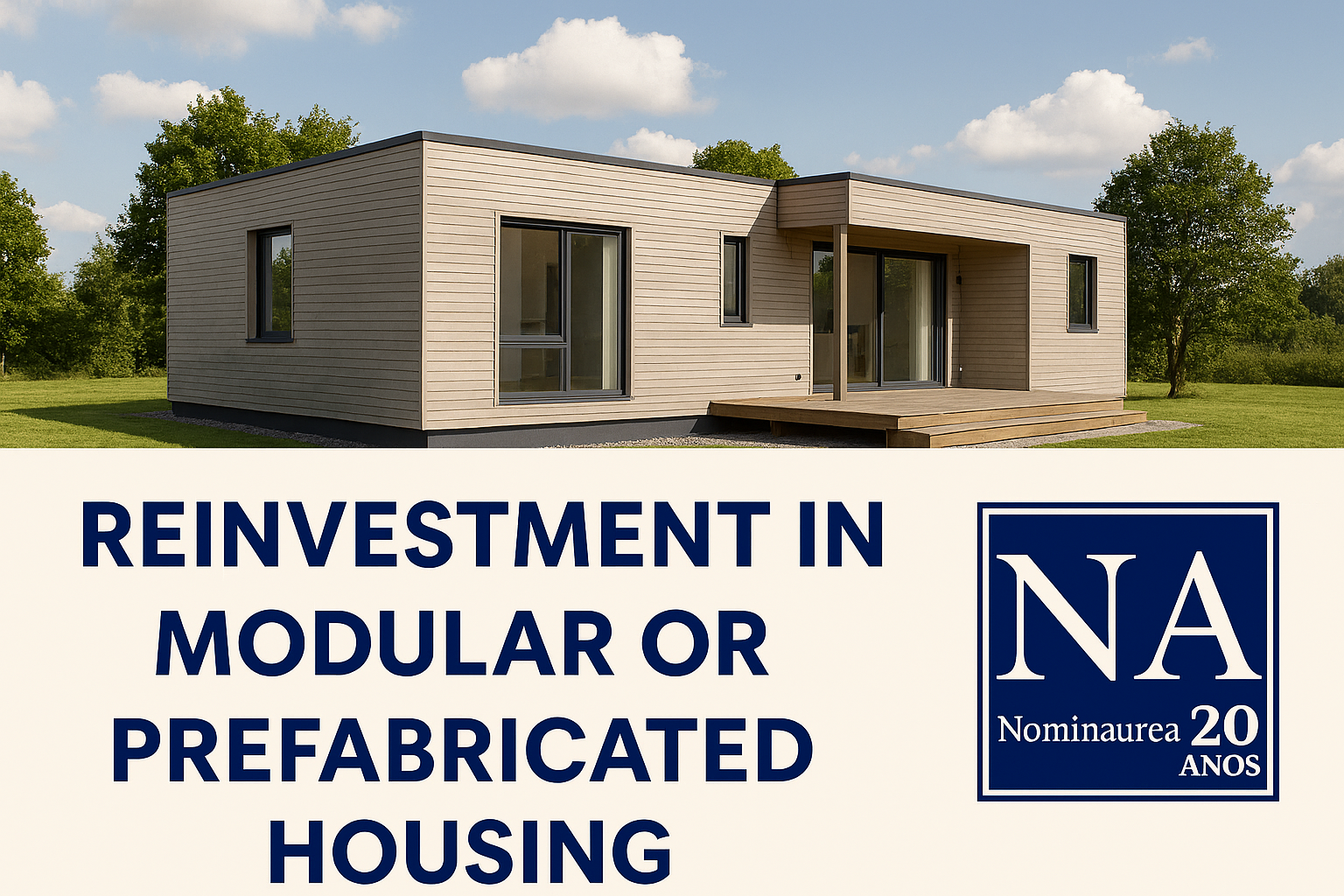
Portugal PIT and Capital gains in Portugal: Reinvestment in Modular or Prefabricated Housing
The taxation of real estate Capital gains under IRPF is one of the topics that raises the most questions among taxpayers in Portugal, especially when it involves the sale of a primary and permanent residence.
In general, when a property is sold for an amount higher than its acquisition cost, a capital gain (Capital gains) may arise and be subject to taxation. However, Portuguese legislation provides mechanisms for tax exemption when the proceeds are reinvested in a new primary and permanent residence.
In recent years, the Portuguese real estate market has experienced significant growth in modular and prefabricated housing solutions. These options offer relevant advantages in terms of construction speed, energy efficiency, sustainability, and, in many cases, cost reduction.
In this context, it has recently been clarified that reinvestment in modular or prefabricated housing can benefit from the tax exemption regime applicable to real estate Capital gains, provided that all legally required conditions are met.
What are real estate Capital gains?
Real estate Capital gains generally correspond to the profit obtained from the sale of a property.
The calculation of the capital gain considers several factors, namely:
- Sale price of the property;
- Acquisition cost;
- Expenses and charges related to the purchase and sale;
- Monetary devaluation coefficients;
- Documented improvement works.
For tax residents in Portugal, only 50% of the calculated Capital gains is considered for IRPF purposes, and it is then aggregated and subject to the applicable progressive tax rates.
Tax exemption through reinvestment
Portuguese legislation provides the possibility of exemption from taxation on Capital gains obtained from the sale of a primary and permanent residence when the proceeds are reinvested in a new property used for the same purpose.
To benefit from this regime, certain conditions must be met, including:
- The property sold must be the taxpayer’s primary and permanent residence or that of their household;
- The reinvestment must be made within the legally defined deadlines;
- The new property must also be intended as a primary and permanent residence;
- The reinvestment must be properly reported in the Model 3 IRPF return.
Reinvestment may include:
- Acquisition of a new property;
- Acquisition of land for construction;
- Construction, extension, or improvement of a property;
- Repayment of a loan taken to acquire the property sold, in legally cases.
Modular or prefabricated housing: tax framework
The recent clarification confirms that modular or prefabricated housing may qualify as eligible housing for the purposes of reinvesting Capital gains.
This means that a taxpayer who sells their primary and permanent residence may benefit from tax exemption if they reinvest the proceeds in a modular or prefabricated housing solution, provided that:
- The housing is intended for permanent use;
- It is legally recognized as a residential property;
- There is proper licensing or urban planning approval;
- The property is effectively used as a primary and permanent residence;
- All deadlines and requirements established in tax legislation are met.
This interpretation follows the evolution of the construction sector and recognizes that new housing formats can fully fulfil the function of a permanent residence for taxpayers.
Importance of urban planning and documentation
Despite the possibility of a favourable tax framework, it is essential to ensure that modular or prefabricated housing complies with all legal and urban planning requirements.
Key aspects include:
- Municipal licensing;
- Land registry;
- Tax registration;
- Allocation for residential use;
- Availability of appropriate infrastructure;
- Compliance with the applicable urban development plan.
The absence of proper legal framework may jeopardize the tax benefit associated with reinvestment.
Tax planning is essential
The exemption regime for Capital gains can represent significant tax savings. However, failure to meet any requirement may result in partial or total taxation of the capital gain.
For this reason, it is advisable for taxpayers to carry out proper tax planning before selling the property and making the reinvestment.
A prior analysis allows:
- Validation of the tax treatment of the transaction;
- Confirmation of applicable deadlines;
- Assessment of required documentation;
- Ensuring the correct completion of the IRPF return;
- Minimizing future tax risks.
Conclusion
The clarification regarding the reinvestment of real estate Capital gains in modular or prefabricated housing represents an important adaptation of tax interpretation to the new realities of the housing market in Portugal.
This possibility opens the door to more modern, sustainable, and efficient housing solutions, without losing access to the tax benefits provided for primary and permanent residences.
However, access to tax exemption depends on strict compliance with the applicable legal, urban, and tax conditions. For this reason, professional tax and technical support is crucial to ensure legal certainty and tax optimization.
How can Nominaurea help?
Nominaurea has a specialized team in tax, accounting, and real estate investment support in Portugal.
We support individuals and companies in:
- Tax analysis of real estate transactions;
- Calculation and classification of Capital gains;
- Tax planning for reinvestment;
- Assistance with completing the IRPF return;
- Evaluation of tax benefits;
- Accounting and documentation support;
- Personalized tax consulting.
If you intend to sell a property and reinvest in a new housing solution, including modular or prefabricated housing, Nominaurea can help ensure a secure, efficient, and tailored tax framework.